by Brett | Jul 13, 2026
In the previous article, we talked about why white ink is so difficult to manage.
The short version is this: white ink contains titanium dioxide particles, and those particles are heavy. They can settle. They can aggregate. If they form clusters or sediments large enough, they can affect ink flow, cause deflected jets, or clog the printhead.
So how do UV printers try to prevent this?
Most stable UV printing systems rely on two basic anti-settling strategies: stirring and circulation.
The first common solution is stirring inside the white ink cartridge.
Stirring creates movement in the ink. It brings settled material back upward, interrupts the settling process, and helps re-suspend titanium dioxide particles that have started to sink.
This reduces the chance that one local area becomes too concentrated with pigment. It also makes it harder for soft aggregations to continue growing.
Using the cocktail party analogy from the previous article, stirring is like forcing everyone at the party to keep walking around. If people cannot stand in one place for too long, it becomes much harder for them to form tight groups.
For white ink, this constant motion matters a lot.
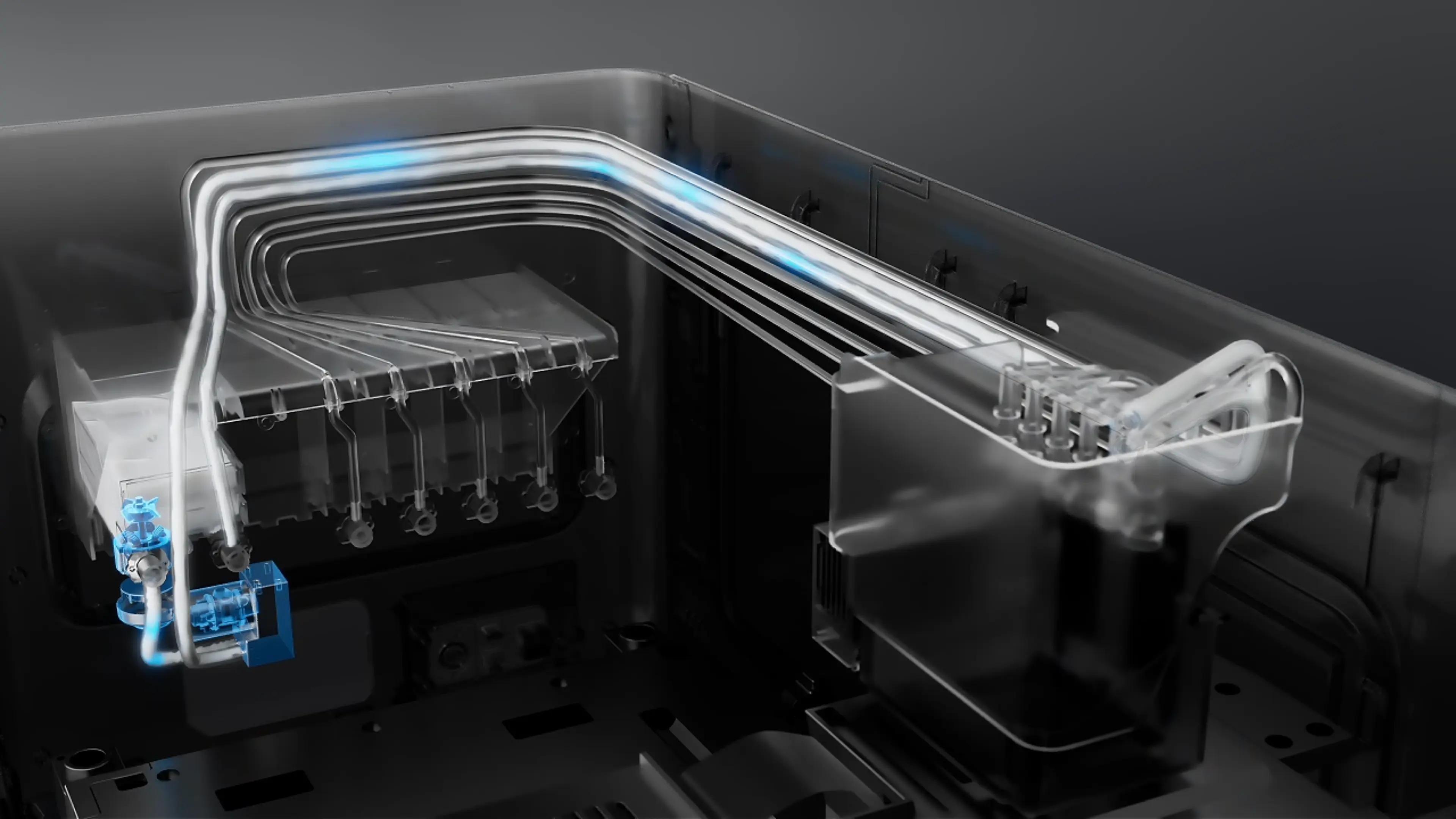
The second common solution is white ink circulation.
The logic is similar to stirring, but circulation focuses on the ink supply path. Instead of only moving ink inside the cartridge, circulation uses flowing ink to flush the path from the cartridge toward the damper or the printhead inlet.
This helps reduce settling in tubes and other parts of the ink supply system.
For printers that need long-term stable output, circulation is often essential. Without it, white ink can sit in low-flow areas, settle, and become uneven in concentration.
If a UV printer sits idle for a long time, or if the printer experiences temperature fluctuations, the risk of white ink problems rises quickly.
Without stirring and circulation, white ink can become uneven. Pigment concentration can increase in some areas. Sediment can form. Once that sediment moves downstream into the ink supply path, it can start affecting flow and printhead performance.
This is why anti-settling systems are not optional decorations. They are part of what makes white ink usable in the real world.
Not completely.
Stirring and circulation are extremely important, but they mainly solve the first half of the problem.
They help keep the ink moving in the cartridge and in the tubing. But inside the narrow spaces of the damper and the printhead itself, white ink can still face aggregation and settling risks.
Some high-end industrial printheads and ink systems support through-head recirculation. This can help move ink through or near the printhead more continuously.
But that kind of system is expensive and complex. A single industrial printhead with advanced recirculation can easily cost thousands of dollars, sometimes $2,000 to $3,000 or more for just one channel. It also requires precise pressure control, flow control, and bubble management.
For a desktop UV printer, especially one designed to be compact and cost-effective, that approach is usually not realistic.
This is the key challenge.
Cartridge stirring helps inside the cartridge.
Tubing circulation helps in the supply path.
But the most fragile area may be the last few centimeters near the damper and printhead. This is where the channels become narrow, the ink volume is tiny, and even a small amount of aggregation can create a visible printing problem.
So the question becomes: how can a desktop UV printer manage white ink in those last few centimeters without relying on expensive industrial through-head recirculation?
That is where Morpho adds its own maintenance strategies.
