by Brett | Jul 13, 2026
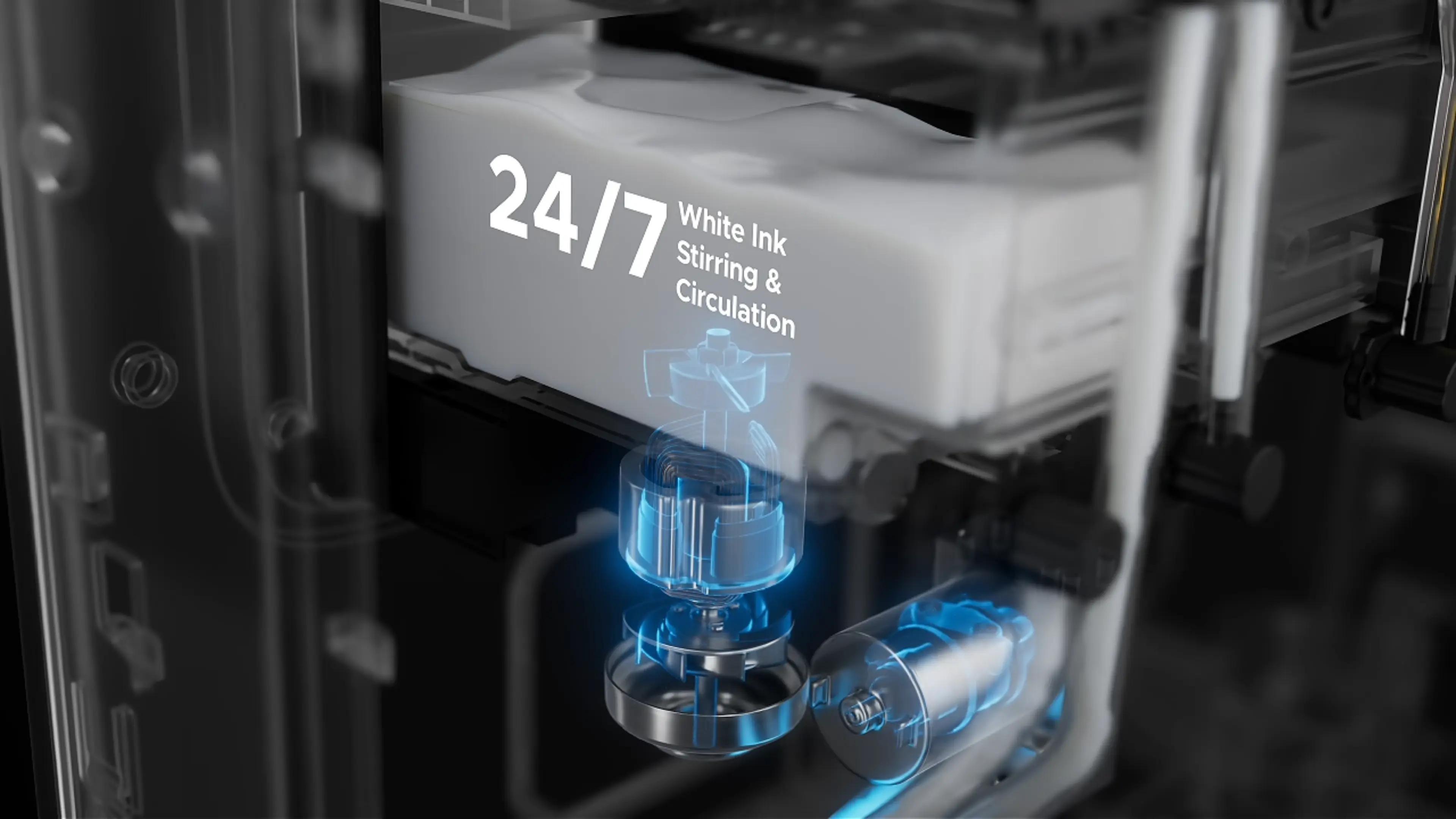
White ink management is not a single technology.
It is a system that combines ink formulation, mechanical stirring, ink circulation, software maintenance strategies, and the physics of how ink behaves inside small channels.
In most UV printers, stirring and circulation are the foundation. They help keep white ink moving in the cartridge and through the supply path.
But Morpho also focuses on what I like to call the fatal last few centimeters: the damper and the printhead area, where the ink channels are narrow and the ink volume is tiny.
Here are two of the ways Morpho tackles that problem.
If the printer is continuously printing, fresh white ink is constantly moving into the dampers and printhead channels.
That fresh ink has already been stirred in the cartridge and circulated through the tubing. In that situation, the system is naturally renewing the ink near the printhead.
But what happens when the printer is not running print jobs?
This is where spitting, also called flash firing, becomes useful.
During idle periods, the machine can automatically fire a very small amount of ink through the printhead. The goal is not to print an image. The goal is to replace old ink sitting inside the printhead with fresh ink from the supply system.
The amount of ink used for this is extremely small, because the actual amount of ink inside the printhead is only a few drops.
Morpho's engineers test these strategies carefully. For example, we need to know how long white ink can sit idle under different temperature conditions before the risk of settling or clogging becomes unacceptable.
If testing shows that white ink can safely sit for a certain amount of time under a certain condition, the spitting strategy is designed around that. It should use just enough ink to keep the printhead healthy, without wasting ink unnecessarily.
In future articles, I will talk more about how Morpho's maintenance strategies combine smart purging and other methods to protect the printer while genuinely saving ink.
Spitting helps refresh the ink inside the printhead.
But what about the damper right above it?
In many traditional printer designs, the printhead carriage only moves along the X-axis, left and right. The narrowest part of the damper is also aligned in a way that makes left-right shaking less useful.
Trying to mix fluid in that tiny space by shaking left and right is a little like trying to shake a block of jelly. The motion exists, but the fluid does not mix effectively.
Morpho's architecture gives us another tool.
Because Morpho uses a true gantry architecture, the carriage does not only move left and right. It also moves forward and backward along the Y-axis.
This matters because the long flow channels inside the damper are aligned along that Y direction.
By controlling the acceleration and deceleration of the printhead carriage along the Y-axis, we can use mechanical inertia to create tiny waves inside the damper. These micro-movements help disturb the white ink, reducing the chance of pigment settling and aggregation.
In simple terms, Morpho can use motion that already exists in the machine to help keep white ink healthier in a place where traditional stirring and circulation cannot easily reach.
For desktop UV printers, the challenge is always balance.
We want stable white ink performance. We want compact size. We want cost to stay reasonable. And we do not want users to waste large amounts of ink just to keep the machine alive.
That is why Morpho combines several layers of protection:
- White ink stirring.
- White ink circulation.
- Carefully measured spitting.
- Smart maintenance logic.
- Y-axis physical assist inside the damper region.
None of these alone is a magic button.
Together, they form a more complete white ink management system.
Just like UV printing itself, white ink management is a fusion of chemistry, mechanics, software, and physics. The better these pieces work together, the more reliable the printer becomes for real creators using it in real homes, studios, workshops, and classrooms.
